
Today, the city of Durrës lies directly above the ancient ruins of Epidamnus. Founded around 627 BC, Durrës is one of the most important cities in Albania and the Adriatic region, rich in history, architecture, and archaeological sites such as the Amphitheatre, City Defensive Walls, Byzantine Forum, Venetian Tower, Ancient Roman Baths, the Basilica of St. Michael in Arapaj, Skanderbeg Fortifications at Cape of Rodoni, and more. Additionally, Durrës possesses an underwater heritage, which adds further value to the city and can significantly promote the development of archaeological tourism.
Following the new administrative-territorial reform, the city of Durrës covers an area of 341.9 km² and has a coastline of 64 km.
Durrës counts around 20 cultural heritage monuments and 12 sites of special significance, all of which are open to visitors year-round, attracting both domestic and international tourists.
So, what can we visit in Durrës?
Follow Us:
The Durrës Amphitheater is a unique public monument in our country. It was built near the traditional city center, on plain terrain and partly on a hill. It is considered an engineering and architectural colossus of ancient times and the work of local masters. It has the shape of an ellipse with a diameter of 136m and a height of about 20m. It was built at the beginning of the 2nd century AD, during the time of the Roman emperor Trajan (98-117). It housed about 15-20 thousand spectators who watched the gladiator matches. The amphitheater had the main entrance from the north and an exit to the south on the same axis. The eastern facade from the city center was two-story with arches and columns and above them a decorative structure with windows. The discovery of the arena would also clarify the function of the amphitheater. Games in ancient amphitheaters were banned by the Roman emperor Honorius in 404 AD. The discovery of the amphitheater began in 1966 and lasted until 1970. Parallel to the monument, medieval tombs were discovered in the arena area. In the following years, several expeditions were carried out, which supplemented the documentary and architectural data on this monument.
After the games in the amphitheater were interrupted, around the 5th-6th centuries AD, a small church (chapel) was built, where religious ceremonies and funerals of the Christian groups of Durrës were held. Initially, the church was decorated with frescoes. Its longevity testifies to later interventions (6th-7th centuries), decorating both sides, southern and western, with unique mural mosaic panels. This mosaic is dedicated to Saint Stephen, martyr of the city of Durrës. Next, Saint Mary is presented as a Byzantine empress surrounded by two angels, the first with an inscription at the top and two miniature attendants at the feet of the figures. The western side preserves fragments of two saints, Saint Irene and Saint Sophia with their respective names. The eastern gallery, which is decorated with a fresco with the figure of Saint Gabriel, also served as a place of refuge for Christian communities.
The city of Durrës was protected from its foundation by surrounding walls built with cyclopean blocks. On this basis, in the following centuries until the Illyrian and Roman civil period, the city walls were expanded along with its topographical development. The surrounding walls that can be seen today were built by the Byzantine emperor Anastasius I (491-518) originally from Durrës, after the damage caused by the catastrophic earthquake of 345. He protected the city with three rows of brick walls, of which 500m in length are preserved on the South-West side. The perimeter of the fence reached 3.5km, 18m high and 3.50m wide. This defensive system was reinforced with pentagonal towers, 60-65m apart. The latest interventions are those of the emperor Justinian (527-565). Also, later, in the century. In the 13th century (1272) Charles of Anjou and in the 14th century (1350) Charles of Topia also carried out defensive reinforcements. The passage of Durrës under Venetian occupation (1392-1501) for 109 years was accompanied by interventions in the defensive system, with circular towers. Meanwhile, the Ottoman invasion on August 13, 1501 reduced the city to the South-Eastern edge (Lagjia Kala) by surrounding it with an 800m wall, 6 times smaller than the Byzantine fence. The Turkish wall descends from the 59m quota, and the city's Clock Tower was built along its length. The Turkish walls were reinforced with towers and ramparts as well as two main gates located on an axis: "Porta e Madhe" and "Porta e Detit".
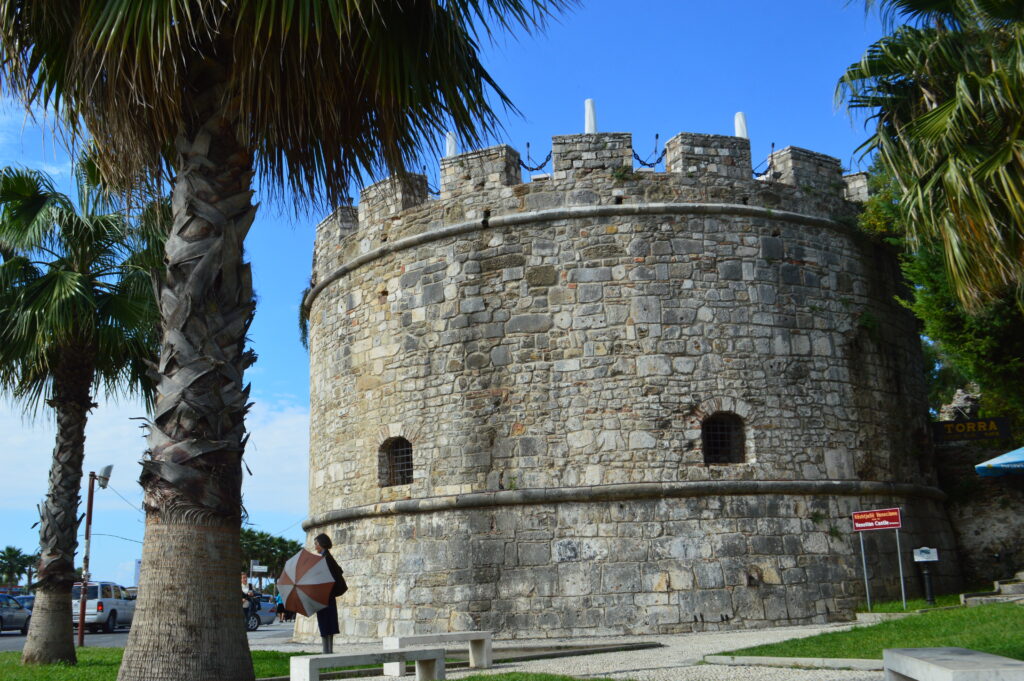
The circular tower (Torra) was built in the 15th century on top of the Byzantine tower. This is evidenced by the presence of blocks from the previous fence, architectural fragments and ancient reliefs. The tower has a diameter of 16m and a height of 9m. The tower is entered through a brick arched gate. The tower is equipped with 5 turrets and 3 compartments (alleys). The perimeter at the top is closed with ramparts. The interior is built of bricks in the shape of a dome. The ascent to the height is done from the inside, with narrow and steep stairs.
The Byzantine market square was built in the traditional center of ancient Dyrrachium. It had a central position in relation to the large public and religious buildings of the Byzantine period. Its architectural appearance testifies to the function of an open, circular market square with a portico. In the center of the market square there is a podium and a well, on a bed of marble slabs that cover the floor up to the colonnade with a perimeter of 40m. Around this radial portico were built service areas. The construction technique, the material used and the cultural layer date this monument as contemporary with the public buildings of the emperors Anastasius and Justinian at the beginning of the 6th century AD.
The public baths (below the “Aleksandër Moisiu” Cultural Center, Durrës) were almost completely discovered in 1960. Given their size and interior, these baths were part of the city’s gymnasium. They preserve the arches of the furnace, the walls, and the floor of the rooms. At the beginning is the apodyterium room (undressing room) followed by the tepidarium (sweating room) which has hypocaust bricks under the floor for the passage of hot steam. Next, in the southern direction, is the frigidarium (cold water room) and finally the swimming pool. The floor is paved with black and white marble tiles, in the shape of a chessboard. To the southwest of the baths, there is a complex of drainage channels and above it lies the main road of the Roman period heading north (Rruga “Aleksandër Goga”).
The Archaeological Museum was inaugurated on April 13, 2002 based on the materials of the first Archaeological Museum, opened on March 13, 1951. The exhibition is organized into three pavilions according to historical periods. The first hall begins with a showcase of prehistoric finds in the city and surrounding areas. In chronological order, the history of the city in the archaic, classical and Illyrian civic periods up to the 1st century BC is followed uninterruptedly. The topographical, economic, political and cultural development of Roman Dyrrachium is then revealed. In terms of thematic aspects, this city testifies to the presence of an indigenous Illyrian population with a rich spiritual world. Durrës is presented as a center with a multi-branch economy and which traded with many Mediterranean centers. The medieval period covers 15 centuries, from the 5th to the 15th century and ends with the Turkish period.
It is a memorial object for the fallen of World War II and the Nazi camps. The mausoleum was designed by architect Kristo Sotiri (1870-1953). Works began in 1947. It is the first and only of its kind, as a mausoleum in our country. The complex of the “Martyrs’ Mausoleum” has an arch-shaped plan. It consists of three main parts: the Mausoleum building, the staircase and the garden. The remains of the martyrs are placed in special niches (chambers). While for those who fell in the Nazi camps, memorial graves (graves without bones) were used. On two marble slabs, the names of those interned in the Nazi camps are written in bronze letters.
The Basilica of ‘St. Michael’ is a cult building from the beginning of the 6th century, during the time of the Byzantine emperor Justinian (527-565). It is located 6 km from Durrës on the western side of the “St. Michael” hill, opposite the “Iliria” beach. It has been completely excavated and measures 65x28m. Architecturally, it represents a three-nave basilica with three corresponding apses. It has two side annexes to the north and south as well as an atrium (inner courtyard with colonnades). Adjacent to the southern nave is a monumental tomb (martyrium), covered with a layer of mosaic treated in two emblems, with subjects from early Christianity, with an area of 54m². The selected motifs, figures, working technique, multicolored stones classify this mosaic as a unique work of art from the Byzantine period of the 6th century, the work of the mosaic masters of the city of Durrës.
In Ishëm, a Basilica was built, known today as the Basilica in Gjuricaj. In its preserved state today, it measures 47 X 20 m. The church is of the basilica type, single-aisled with three naves. At a later time (7th century), a small chapel was adapted inside the central nave.
Part of the walls, floors and some architectural details made of marble are preserved in relatively good condition from the monument. According to researcher Halil Myrto, the objects discovered in this Basilica date back to the 4th – 3rd century BC, as well as the 5th – 6th century AD.
The church is built of stone masonry and 5 rows of bricks bonded with lime mortar. On the floor of the building, architectural details made of marble have been found, such as: columns (fragmented), capitals, imposts, iconostasis plates and other plates with relief decoration. According to the author, objects dating back to the Hellenistic period, the first centuries of our era, as well as the middle and late Middle Ages, have also been discovered.
The castle was built in 1572-1574 by the local feudal lord, Mehmet, on the orders of the Ottoman Sublime Porte. After the completion of the works, the castle was equipped with cannons and a garrison of soldiers was stationed in it. The castle, with a rectangular layout (100 X40 m), has two gates and 5 watchtowers.
From historical sources it is precisely known as the purpose and time of its construction. During the 16th century, Ishmi was included in the Sandžak of Ohrid, which was a province full of peasant revolts and unrest for the Ottoman Empire. For this reason, the feudal lord Mehmet proposed to the Sublime Porte that a fortress be built in Ishmi, which would protect the vilayet from the rebels, on condition that the Sandžak be given to him as an undertaking for the collection of state fiscal obligations.
The castle is built on a hill east of the village of Ishëm. From it, a wide horizon opens up to the view. From the north and east, the fertile plain of Ishëm is observed and the view is divided into the Krujë - Dajt mountain range, while from the west, the mouth of the river, Cape Rodonit and part of the Adriatic Sea coast are observed. The walls are strengthened by five towers which, with the exception of a corner tower with a circular plan and another pentagonal one, have rectangular shapes. Tower I and Tower II have been preserved at the height of the walls, while towers III, IV and V are ruined. Of these, only the side walls are preserved on the ground level, while the front walls have completely disappeared.
The hamam (bath) is a public building with typical architecture of the Turkish period. It was built in the 18th century in the southeastern corner of the medieval city. In the center there was a spherical dome with a height of 5.8 m, equipped with 12 small windows for ventilation. The premises were heated with steam through ceramic pipes. The oven is located in the back of the hamam. It was badly damaged and was reconstructed in 1980.
The name Top-Hane indicates its initial function as a gunpowder production workshop. The presence of a water source in the Varosh neighborhood (outside the castle) created the possibility of building a well for its inhabitants, around the 16th century. The well was built on a rectangular stone base, surrounded by four granite columns from the Byzantine period, which were reused.
House with a veranda built in the second half of the 19th century. In the 1930s, it was also the headquarters of the English consulate. This building has been declared a “Cultural Monument” for its architectural values. After its restoration in 1983, the “Popular Culture Exhibition” was established. In three exhibition rooms, the artisanal values of the area of our city and its surroundings are revealed. Two other rooms are dedicated to the figure of the actor of Albanian origin Aleksandër Moisiu, named “Aleksandër Moisiu Museum Room”. Moisiu completed primary school in Durrës, and for this reason in 1928 he wrote his memoirs in the form of a sketch entitled “Childhood Dream”.
The "Fatih" Mosque dates back to the time of Sultan Mehmet II the Conqueror (Fatihu). It is the oldest Islamic religious building in our country. It was built around 1502-1503, built on the ruins of a Christian religious building (a basilica from the 11th century).
The Bank of Albania “BKT” was built in 1928. Its foundations are on the southeastern tower of the Byzantine wall, called the “Great Bastion”. The building was designed by Italian architects and built by Durrës masters. Compositionally, this building belongs to the works of the Baroque style, which was used for the first time in our country. A human sculpture (woman) is placed on the Bank, which symbolically represents the war, resistance and victory over the centuries and the prosperity of the country.
The royal palace was built in 1937. It was designed at the highest point of the hills (98 m) and has a dominant position in relation to the city and the sea. Architecturally, it represents the building style (neo-classical) used at the beginning of the 20th century. On the front facade of the Villa, the figure of the national hero Gjergj Kastriot Skenderbeu stands out, placed in profile to the right, on horseback and with a sword in hand.
The memorial is dedicated to Mujo Ulqinaku (1896-1939), “Hero of the People”, one of the first fighters of the armed resistance against the Italian fascist occupation on April 7, 1939. The memorial was created by the “Sculptor of the People” Kristaq Rama. Mujo Ulqinaku was born in the city of Ulqin into the family of a sailor. He had the rank of non-commissioned officer in the navy unit in Durres. He was positioned on the front lines of the fighting from the first hours of the Italian fascist occupation. Mujo Ulqinaku and his comrades, with their resistance and patriotism, showed unparalleled bravery.
The Durrës City Hall was built in 1929, on the traditional city square. The city hall is designed with three floors and basements. The first floor, at the entrance to the facade, is treated with three arches, while the second floor above it has an internal balcony with columns. The building culminates with a square tower, on the left, where the City Clock is also located. The facade is decorated on both sides with relief decorations in the form of medallions, which have the symbols of a sailing ship as well as a sheaf of wheat ears.
“Rruga Tregtare”, today “Bulevardi Epidamn”, was built after the damage caused by the earthquake of 1926. With the opening of this road, the implementation of a modern regulatory plan of the city of Durrës began according to the urban development indicators of European cities. On both sides of this road, two and three-story buildings (villas), in the style of contemporary architecture, with diverse decor, were built. The upper floors served as housing while the first floors were for trade, from which it also took the name “Rruga Tregtare”. They are still preserved today as representatives of the architectural constructions of the 1930s-1940s. 20th century
The Catholic Church "St. Lucia" with a bell tower, was built in 1909. The church represents a religious building with its respective functional premises. It is also known as an important center where the patriotic cleric Dom Nikoll Kaçorri (1862-1917) celebrated mass. This personality with a good reputation among citizens was also the initiator and supporter of the ideas of the patriotic movement for the teaching of the Albanian language and for the independence of Albania. In the cell of this church, the patriots of Durrës gathered, from where important decisions were made that influenced the historical events of the city, such as the raising of the national flag in Durrës on November 26, 1912.
The Water Tank or Depot is a construction from the late Middle Ages and is located behind the Mausoleum of the Martyrs. The water was collected from the natural springs of the hilly area. It is a building with a vaulted roof covered with tiles and surrounded by buttresses. It has five entrance steps and an arched door above which there is a circular window for ventilation.
The house was built in 1884, the date of which was written in iron letters on the semi-arch of the main gate along with the initials Z.M., the name of the owner Zis Margariti. This house served as the residence of the Austro-Hungarian consulate (legacy) in 1914.
The Church of the Apostle Paul and Saint Asti was built during the years 1994-2002, and was inaugurated on May 3, 2009. The Apostle Paul is known as the first preacher of the Christian religion in Illyria. In his memory, a church was built at the northern end, at “Cape of Paul” today “Cape of Pallas”. Saint Asti is the first martyr, who was martyred in the year 100 AD in Durrës, during the period of the Roman emperor Trajan (98-117).
The Great Mosque was built in 1938. The chosen topographic position with its facade facing east completes the ensemble of public buildings in the city's central square. The "Movement against Religion, Religious Prejudices and Backward Customs" of February 6, 1967, demolished its dome and minaret, and transformed it into a cultural institution, named the "Youth Palace".
After the 1990s, the Great Mosque returned to its function as a religious building and preserved its original architecture. Construction was carried out in two phases: during 1992-1994 and later during 2004-2006.
The Sulejman Kulla Tower is located in the village of Kullas i Ishmit. It is the only tower in the Durrës district. It was declared a Cultural Monument around 1983. It is a three-story building built of stone. The tower has about 20 battlements, which served to protect the tower in case of attack. The first floor of the tower served as a warehouse, while the other floors were for living. The tower also has two balconies that served the residents. The tower was restored around 1988. Today it is in functional conditions and can be visited.
Among the fortifications built by Skanderbeg to protect the country in the war against the Turkish invasion, is the Castle on Cape Rodonit, known by the toponym "Skanderbeg's Castle", which was built around 1460.
The castle had a rectangular plan and was equipped with 4 defensive towers at each corner. It was destroyed by the Turks in 1467 and rebuilt by Venice 33 years later. Today, the main tower, 10 m high, and some defensive walls, 3.5 m thick, are preserved.
The Church of St. Ndoi is located near the seashore north of Skanderbeg's castle on Cape Rodoni. The church belongs to the Romanesque-Gothic architectural type and was built at the end of the 13th century.
Written sources mention that there were three important churches near the Cape: the Church of Saint Mary, that of Saint Anastasia, and that of Saint Collet, where the Franciscan convents exercised their activity.
On the northern and southern walls of the Church, blind arches with a sharp profile pass over pilasters. On the eastern wall, there is a semicircular apse, both on the inside and outside. Inside the church, two layers of mural paintings can be seen on the masonry. According to history, Skanderbeg spent his vacation on the occasion of his marriage. The church was restored in 2003.
From the Wall of Porto Romana, about 7 km north of the city of Durrës, the remains of a wall that once closed the narrow strip of land, through the sea and the marsh, are still preserved today. Hezei briefly mentions these constructions, noting that the walls closed a system that had a length of no more than 200 m, and their system of brick strips bore a great resemblance to the more regular and older parts of the great enclosure of Durrës.
According to researchers, the northern wall that closed the strait was equipped with rectangular towers placed at equal distances.